How to collect guest photos after a party, and actually get them
The shared link dries up after a week and nobody chases it. Here are four ways to collect guest photos, what each one costs, and the one that works.

Photo and video
Film 36
Film 36 is the disposable camera app that gives every guest 36 shots, with no preview and no retakes, then develops every roll the next morning at 10.
Free up to 10 guests, with photos kept for 7 days after developing. Beyond that, the host buys Unlimited party, which opens 1,000 guests and 90 days of storage. It is a one-off purchase for that one party, and there is no subscription.
36 shots
per guest, with no preview, no deleting and no retakes
10 AM
developing time the next morning, the same for everyone
1,440 views
forty guests at thirty-six shots, one night through every pair of eyes
01 Where this started
Everyone takes photos, nobody shares them. They stay in forty private camera rolls, and the shared album comes down to the three pictures posted the next day by the two people who remembered.
Shared albums have existed for fifteen years and solve none of it, because you have to think of it, come back to it, and upload yourself. A guest three drinks in does none of those three things.
Film 36 takes the problem from the other end. Every guest gets a roll of 36 shots, fires without ever seeing an image, and everything develops automatically the next morning. There is nothing to upload, because there is nothing to collect.
The problem was never taking the photos. It is getting them back together.
02 Getting in
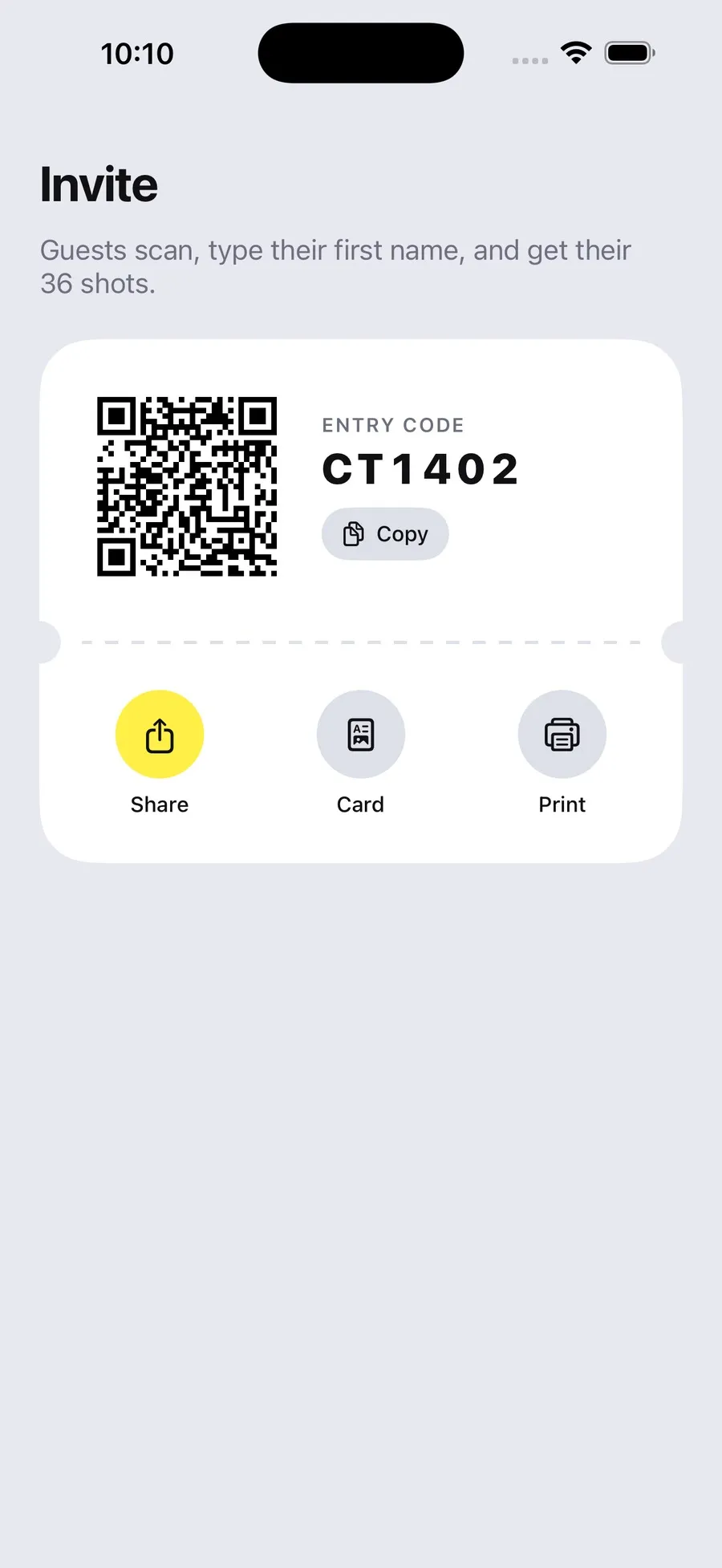
The host creates the party, gives it a name, a date and a time window, and gets six characters back. That is the whole thing to hand out.
The guest types the code, types their first name, and the roll opens. Ten seconds, no account, no email address. On Android there is nothing to install at all: the code opens the camera in the browser.
The invite panel is shaped like a ticket, QR on one side and the code on the other. Three ways to pass it on: a link, a printable card as a PDF, or straight to a printer, to sit on the tables at a wedding.
03 The night
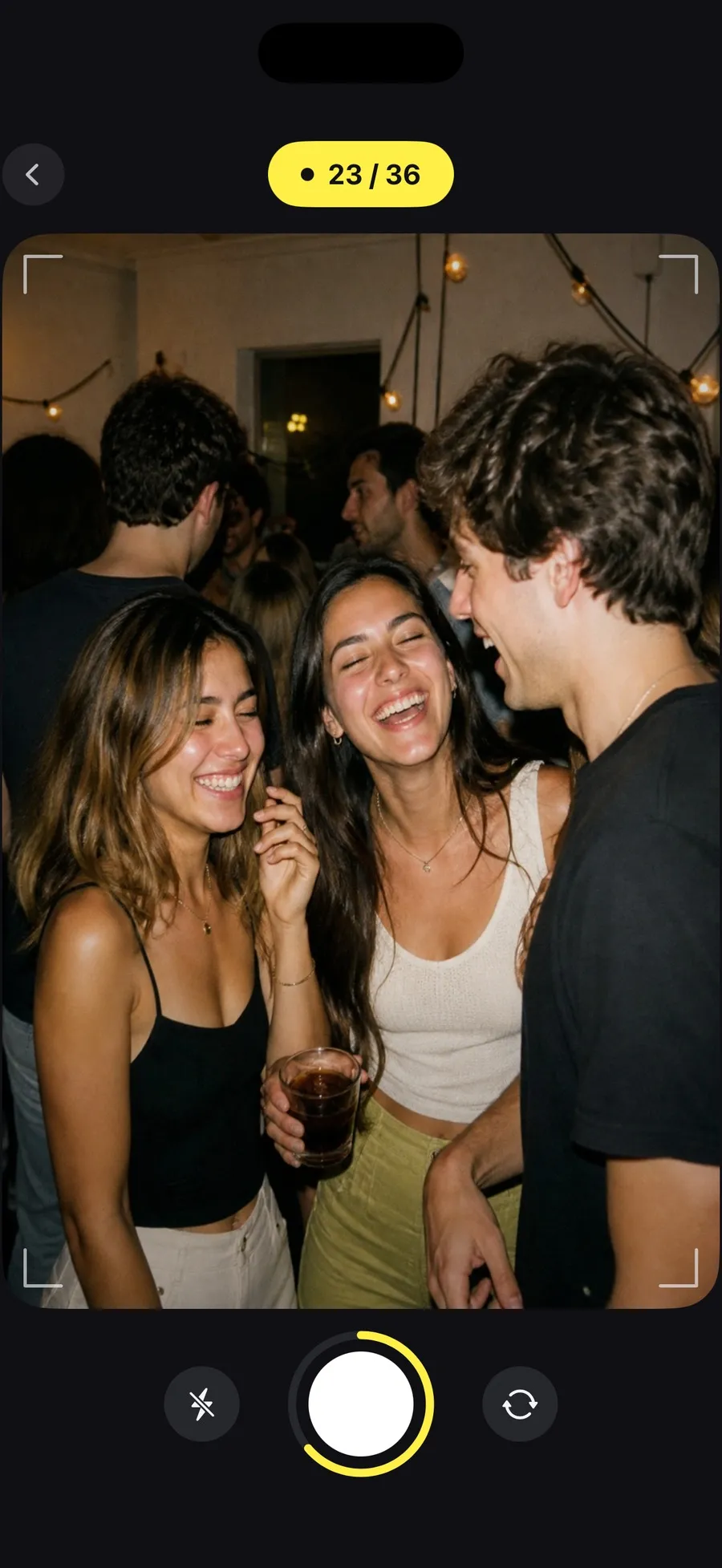
The camera holds nothing but a viewfinder, a shutter, a counter and the flash. No thumbnail, no gallery, no retake. The yellow counter runs from 36 down to 0 and that is the only information on screen.
The missing preview is what changes behaviour. You cannot check, so you do not spray and sort later. Every press becomes a choice, and the number of shots can be set to 12, 24 or 36 depending on how long the night runs.
The shutter cracks and the advance wheel turns under your thumb. Small details, and they are what make it feel like an object rather than an app.
A barn with no signal changes nothing: the photo stays on the phone and leaves on its own once the signal comes back.
You cannot check. So you watch the party instead of watching a screen.
04 The wait
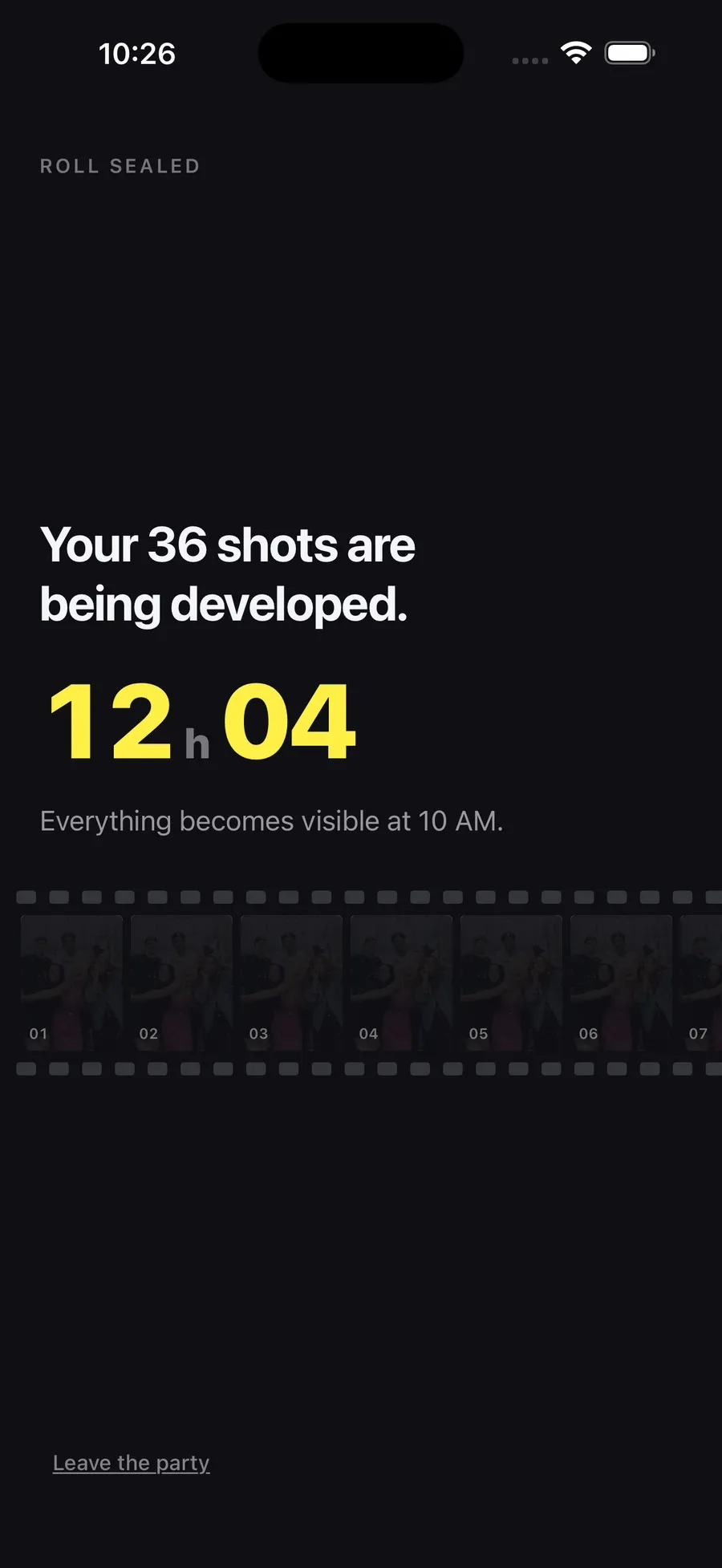
Roll finished or party over, the shots wait on night black, under a contact strip where the frames stay deliberately latent. A countdown gives the developing time.
Nobody sees anything before 10 AM. Not even the host, and it is the server that enforces it, not just the app. The rule therefore holds against someone actively trying to get around it.
This is the part of the product I cared about most, and the one that sounds most arbitrary when you describe it. The wait is not a technical constraint, it is what turns the next morning into a second party.
05 The reveal
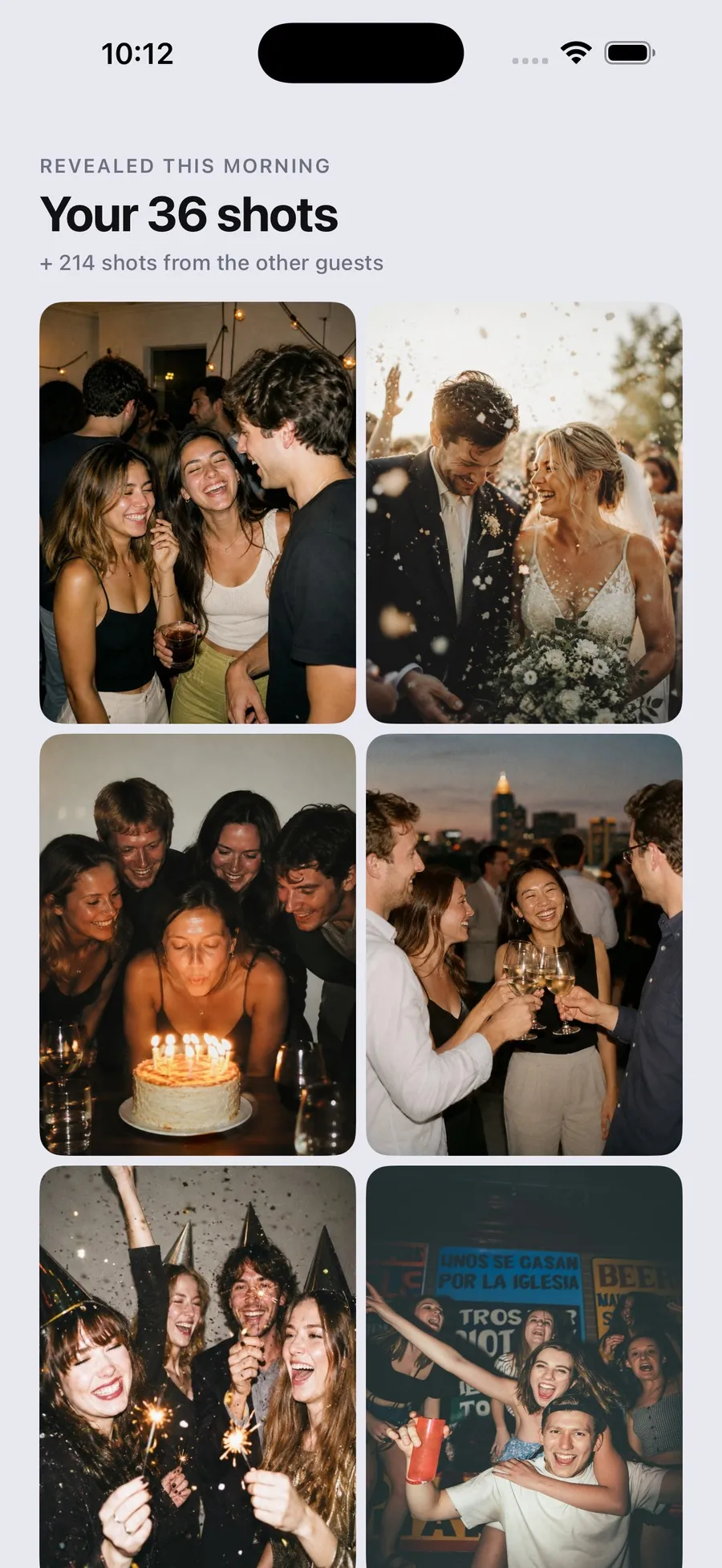
At 10 AM a notification lands, and the photos surface one by one like a print in its bath. Every roll comes out at the same time, the host's and the guests' alike.
That is where the arithmetic gets interesting. Forty guests at thirty-six shots is up to one thousand four hundred and forty views of the same night, and the vast majority show things you never saw. The far table, the laughing fit in the kitchen, you from behind.
No single photographer produces that, however good they are, because they can only be in one place at a time.
06 Sorting
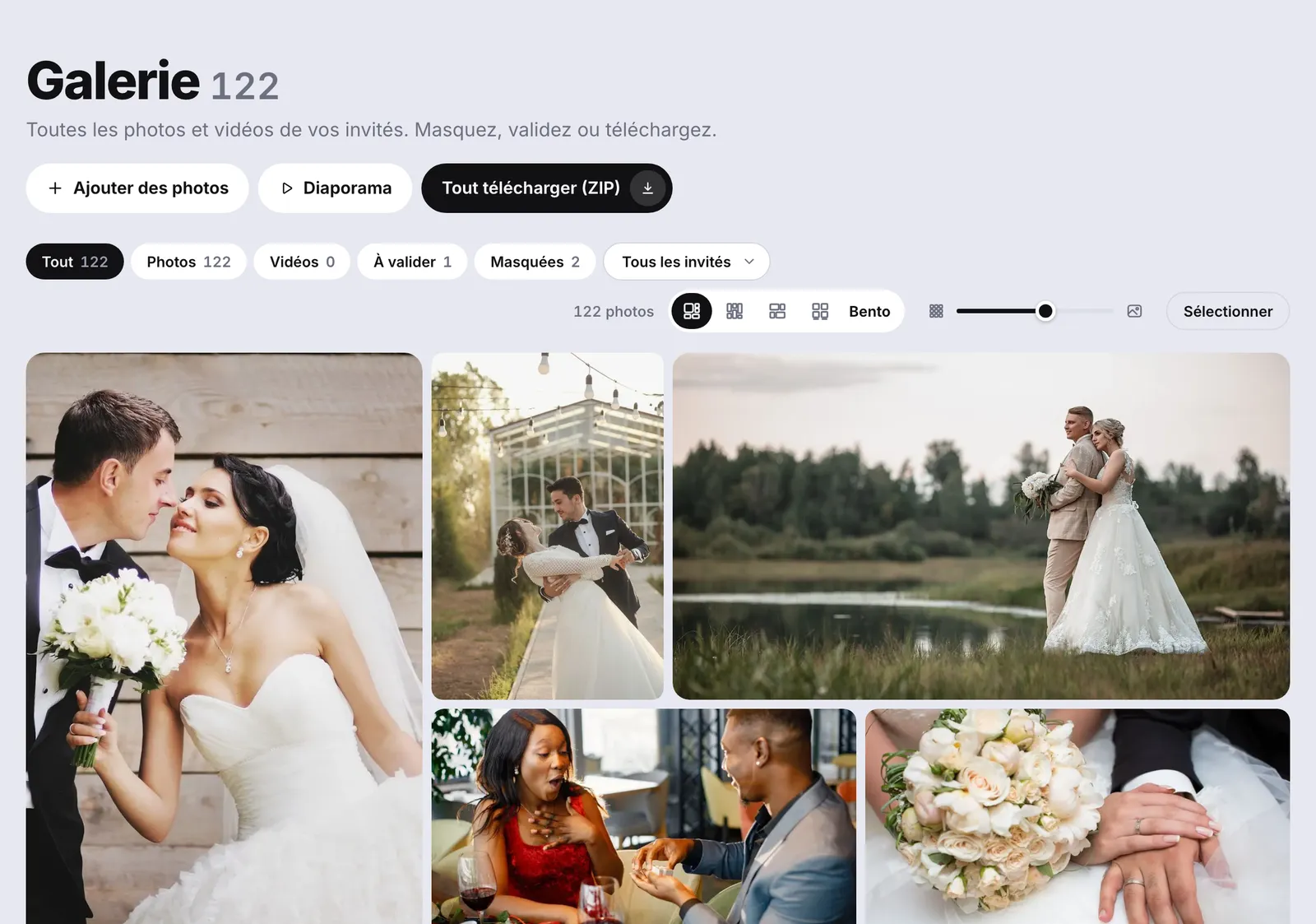
Each photo can be saved, hidden, or permanently deleted by whoever took it. The host decides what goes into the shared selection and what stays out of it.
Saved photos export to the iPhone's photo library. In the other direction the app never reads anything: its access to your photos is write-only.
The rest erases itself seven days after developing, or ninety days with Unlimited party. That is written down before the first photo, not on a page you find afterwards, because promising to forget is what puts people at ease.
07 The look
Five looks to choose from: naturel, sable, brume, studio and argentique. Naturel is barely noticeable, sable pulls highlights towards gold, brume opens the shadows towards turquoise, studio softens faces, and argentique goes to reportage black and white. The names stay French in both languages, the way real film stocks keep theirs.
The technical point that matters: the shot is stored exactly as it left the sensor and the film is applied at display time. So the host can change the look of the entire gallery after the fact, and new films can arrive later without freezing older parties.
The same control screen holds the rest: shots per guest, the vintage timestamp burned into the corner of the frame, the developing time, who has joined, and the ability to remove someone or promote them to admin.
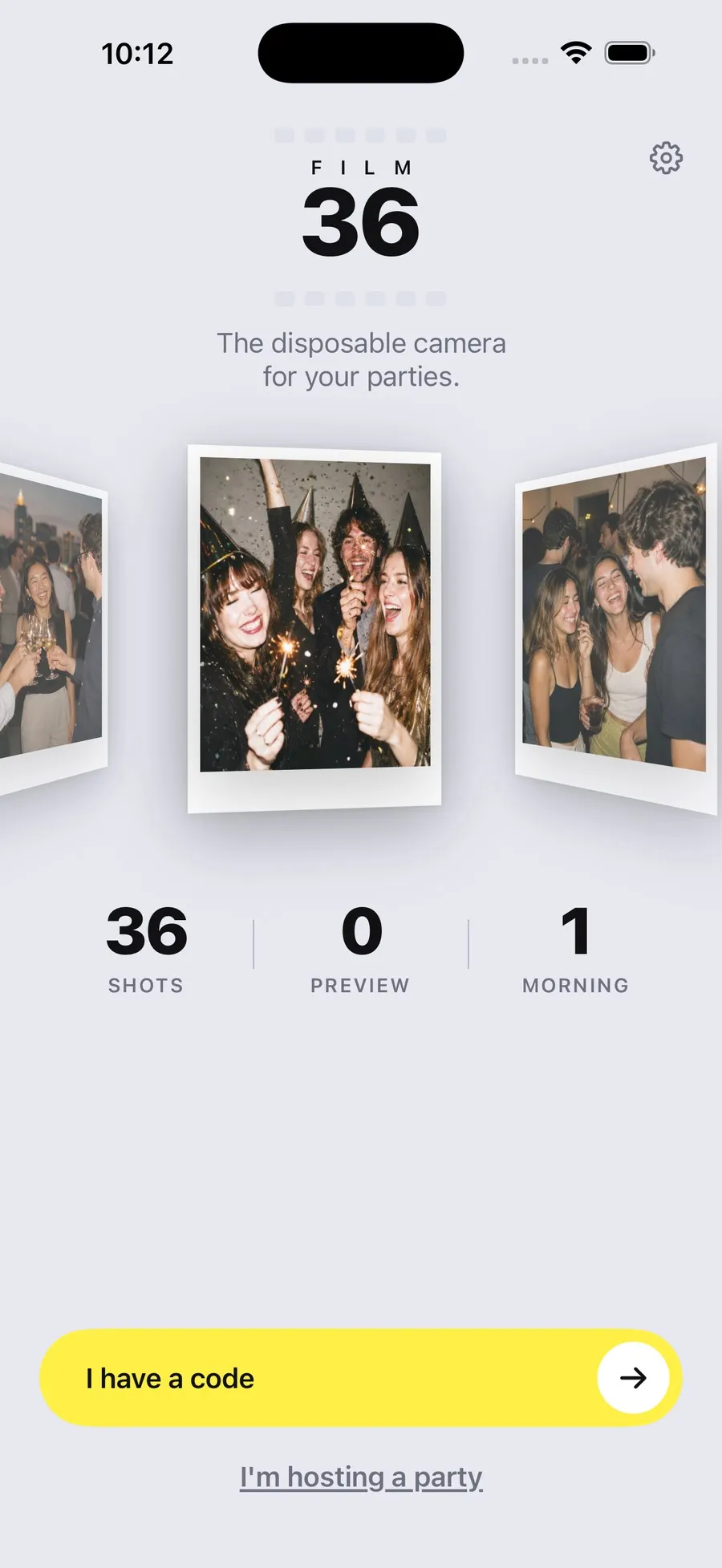
Six characters, a first name, and the roll is open. Android guests go through the browser with nothing to install.
The constraint is explained on first launch. Discovered mid-party, it would read as a bug.
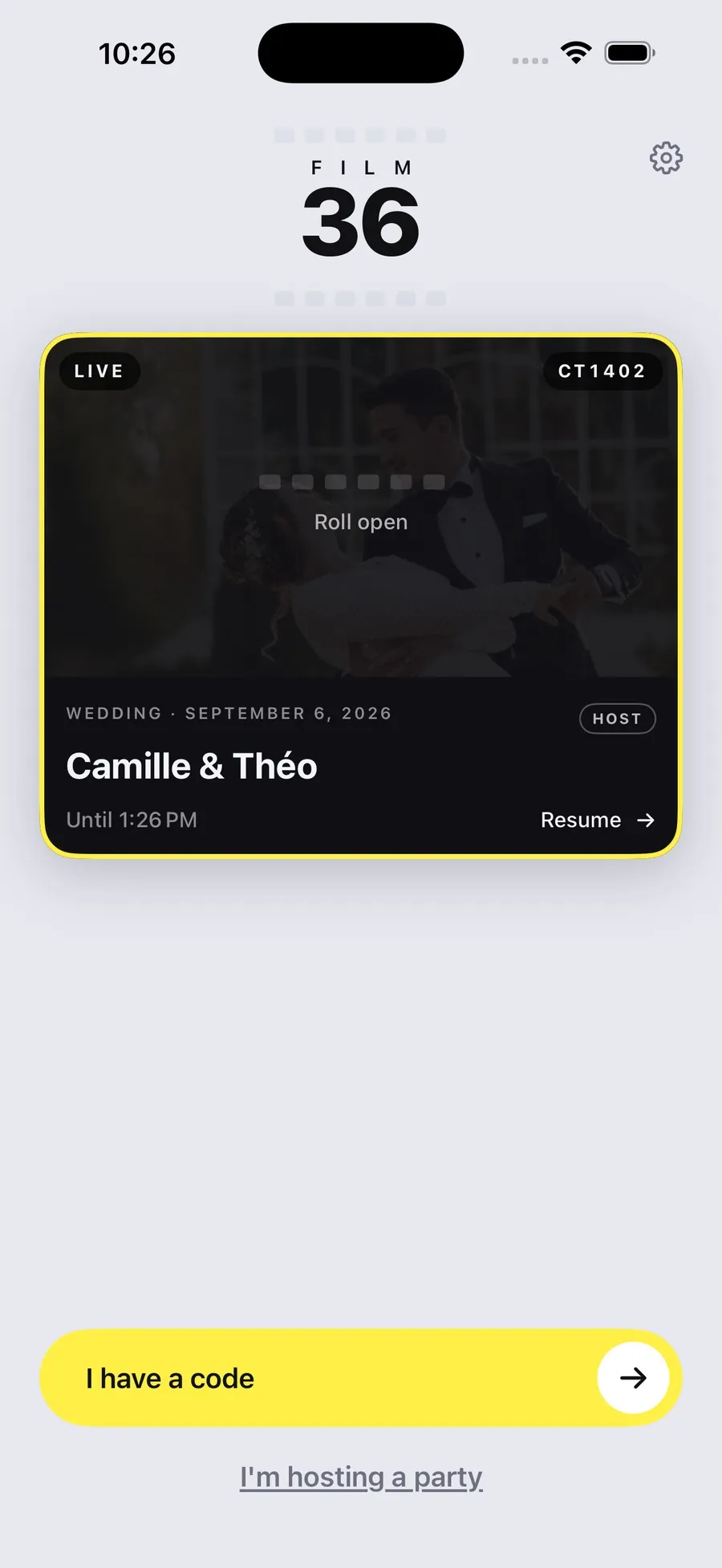
Nothing is visible before 10 AM, not even to the host. The rule does not live in the app alone.
Seven days after developing, ninety with Unlimited party. Hosted in Europe, no trackers, no advertising.
It does not do video. The 36-shot constraint means nothing on a format measured in seconds, and a party filmed by forty people produces four hours of footage nobody will ever watch.
It also does not try to imitate the grain of one specific stock, with real film names and calculated halation. The five looks are deliberately restrained: they dress a photo, they do not disguise it. A party photograph already carries plenty of flash and movement.
Finally, it does no face recognition and sorts nothing automatically. Sorting is a pleasant moment when it covers photos you are discovering, and that moment is exactly what the app is built to create.
This is the most important design decision in the product, and it is invisible.
The rules of the game, 36 shots, no preview, no deleting, developing the next morning, are explained on the very first launch, before the first photo. Discovered mid-party they would read as bugs: the guest would look for their gallery, fail to find it, and conclude the app was broken.
Announced up front, they are the rules of a game you chose to play. It is the difference between a broken lift and a building without one.
Film 36 has been on the App Store since 16 August 2026, in French and English, on iPhone from iOS 17.
The most requested addition is more films, which the current architecture makes easy since the look is never baked into the file. A party developed last year will be able to take on a film added this year.
The host creates a party and hands out a six-character code. Each guest joins with that code, without creating an account, and gets 36 shots. They shoot without ever seeing an image, then everything develops automatically the next morning at 10, into one gallery shared by all the guests.
Because those are the rules of the game, and they are what changes behaviour. With no preview you do not spray and sort later, and every press becomes a choice. It is also what makes the next morning a real moment rather than a file transfer.
On iPhone, yes, and it takes seconds. On Android, no: the code opens the camera straight in the browser. Either way no account is asked for, no email address and no phone number.
Thirty-six by default, like a roll of film. The host can drop it to 12 or 24 depending on how long the night runs, before the roll opens.
Nothing you can see. The photo stays on the phone and leaves on its own once the signal comes back. That was essential, because a wedding in a barn has no signal.
Only the guests of that party, and nothing is visible before developing time, not even to the host. Photos are deleted automatically seven days after developing, or ninety days with Unlimited party. Hosting is in Europe.
The free tier covers 10 guests with 7 days of storage. Past that, the door closes. Unlimited party opens 1,000 guests and 90 days of storage, as a one-off purchase for that party. There is no subscription, and the price is whatever the App Store shows in your region.
Yes. The shot is stored exactly as it left the sensor and the film is applied at display time, so the host can change the look of the whole gallery afterwards, as many times as they like.
Download
Film 36 is on the App Store.
 Film 36 · On the web
  Film 36 · On the web