How to make a travel journal you actually finish
Almost every journal stops on day four. Here are four ways to make a travel journal, what each costs in effort, and the one that survives a long trip.

Travel
Soñj
Soñj is a travel journal app that finds your past trips inside your own photos, with nothing for you to type, and turns each one into a poster you can print.
The app is free. A poster printed on fine art paper and delivered runs from €29 at 30 x 40 cm to €69 at 75 x 100 cm, shipping and VAT included. The print file on its own is €4.99.
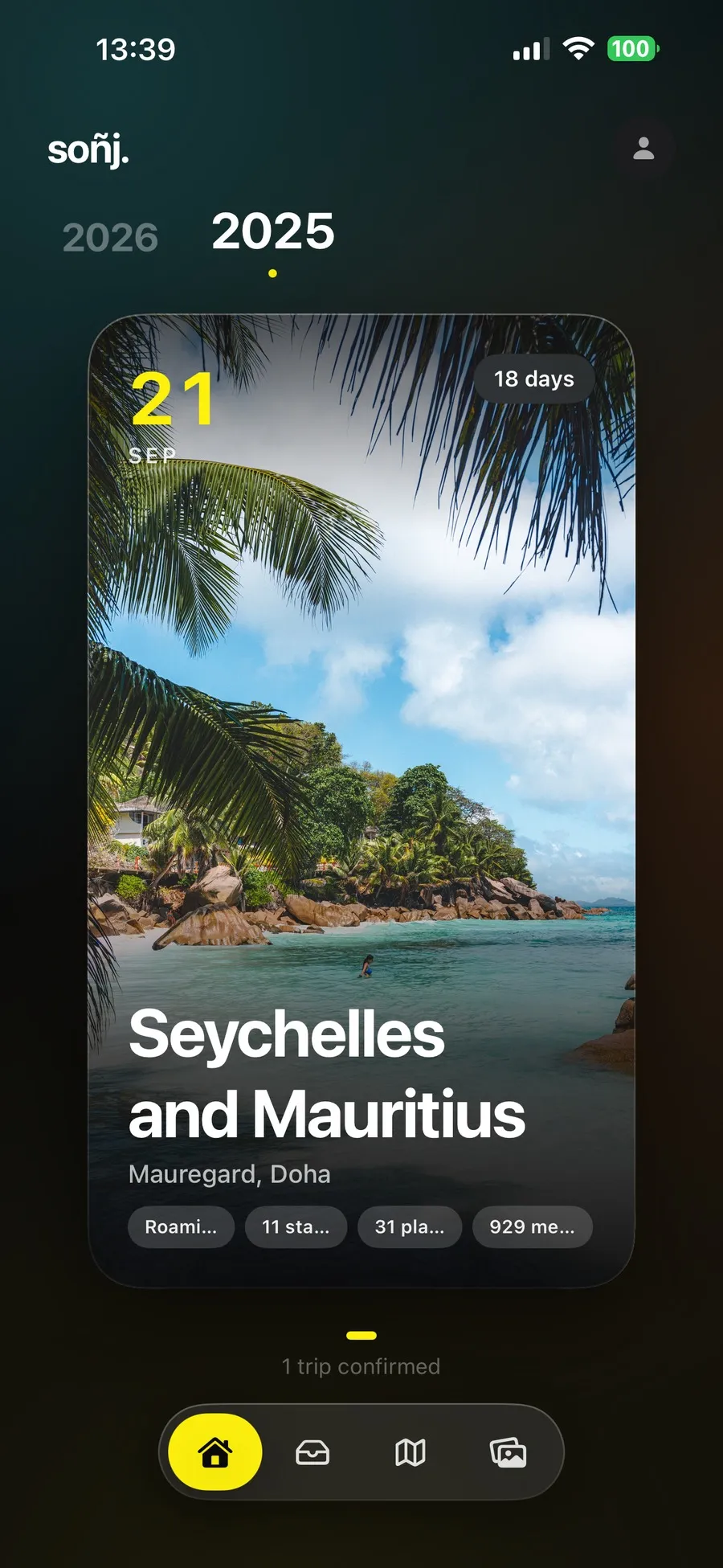
0 typing
the trip is worked out from the photos you already took
0 tracking
no background location at all, the analysis runs on the iPhone
4 templates
timeline, route, mosaic, editorial, composed on their own
01 The starting point
I have tried several travel journal apps. The story is always the same: for the first three days you note the stops, you add the photos, you write a line in the evening. Then you are tired, there is no signal anywhere, and the journal stops on day four of a trip that lasted eighteen.
The problem isn't laziness. It is that the traveller is asked to do the same work twice. They have already documented the trip, meticulously, without thinking about it: nine hundred photos, each one stamped with a time and a location by the iPhone at the moment it was taken.
Soñj starts from there. It asks you for nothing, it reads what is already written in your photos and rebuilds your trips from it. The name comes from Breton, where it means the memory, the thought you hold on to.
You have already written your travel journal. It is in your photo library, and nobody has ever read it.
02 The detection
The app reads the dates and locations written into your photo library's metadata, and works out your movements from them. An eighteen day stay in the Seychelles comes back with its eleven stages, its thirty-one places and its nine hundred and twenty-nine photos without you typing a single letter.
What the engine detects is not confirmed automatically. The "To sort" tab shows you the proposals one at a time, along with the reasons that produced them: how many days were spent away from home, the volume of photos, the geographic spread. You confirm, you reject, you fix the dates, you split one in two, you merge.
So that everyday life isn't mistaken for a trip, you declare where you live. It is the one thing the app really does ask of you, and that information never leaves the device.
03 The journal
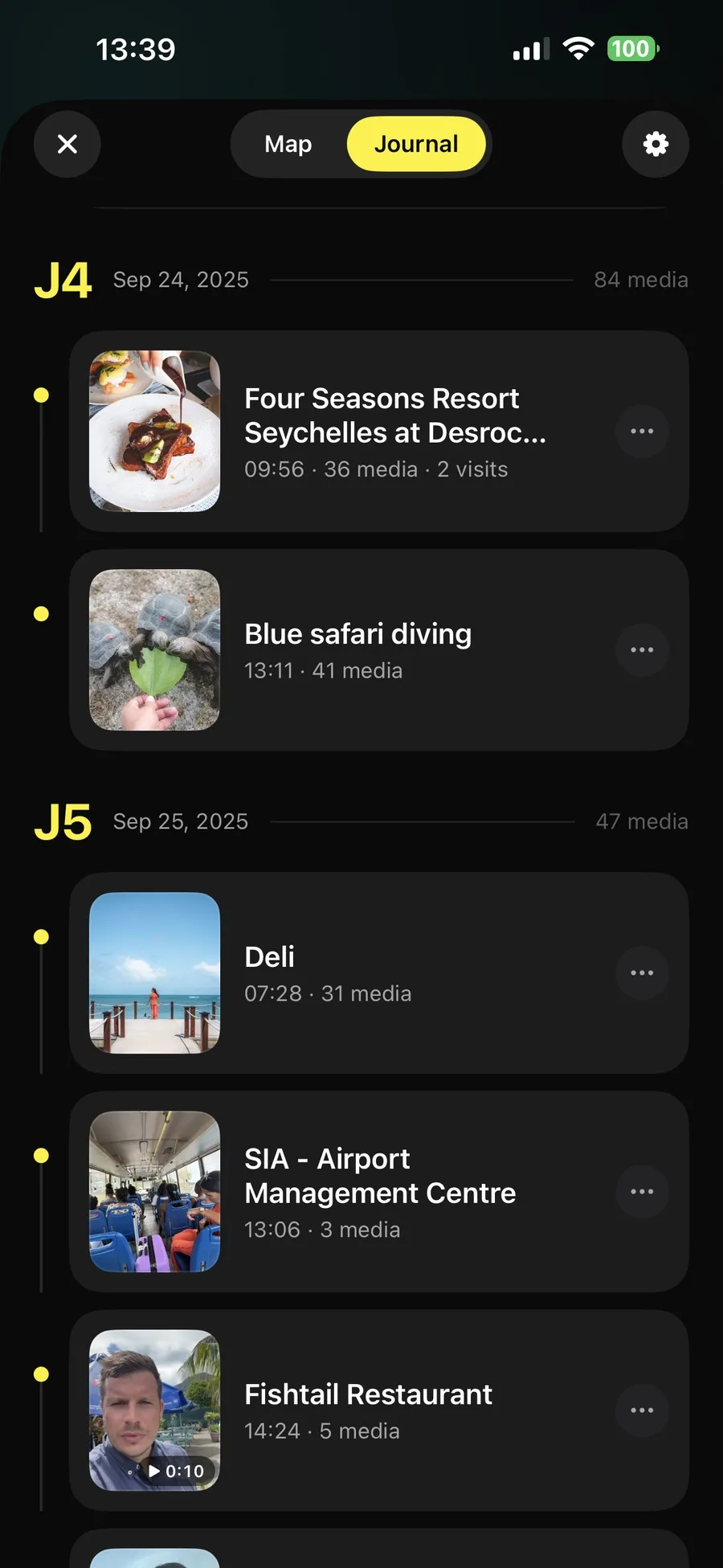
Every trip has its journal: a day, the places crossed in order, the time you passed through, the number of photos taken at each. It is the most faithful reconstruction I have seen of what actually happened, because it doesn't depend on what you remembered to write down.
Everything can be corrected. You rename a place, from the suggestions or freely, you remove one that has no business being there, you choose the cover photo, you mark your favourites.
Favourites are written back into Apple's Photos app. What you like here, you find over there, in the library you were already using.
04 The map
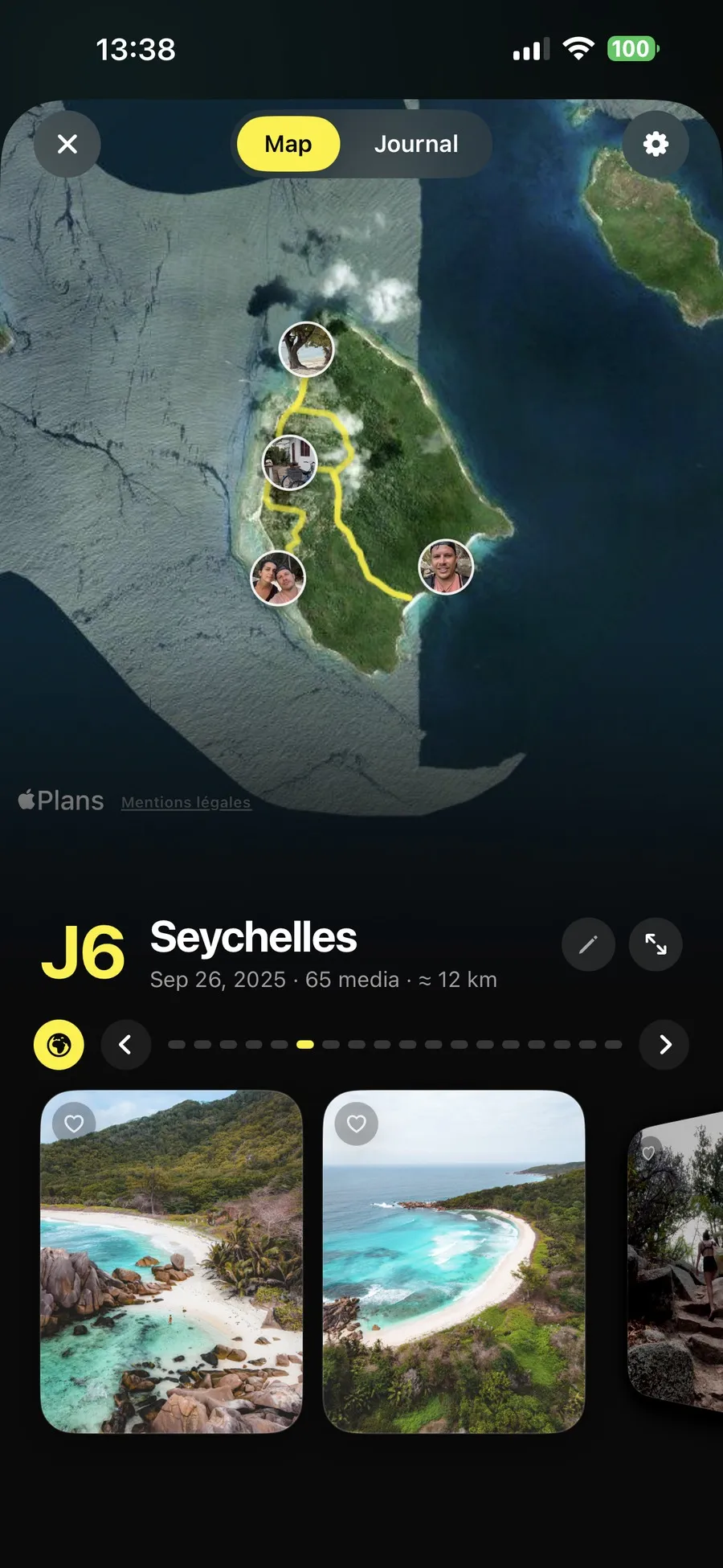
Every day has its map. The places sit on it as pins illustrated by their own photo, and the route joins them in the order you travelled them.
The yellow line is the recorded route, the one the photos let us reconstruct with certainty. Where points are missing, the estimated stretch is drawn dotted rather than solid. A map that invents a route and passes it off as true is worth nothing.
At the top of the view, the day's kilometre count. At the bottom, the day's photos, in order.
05 The globe
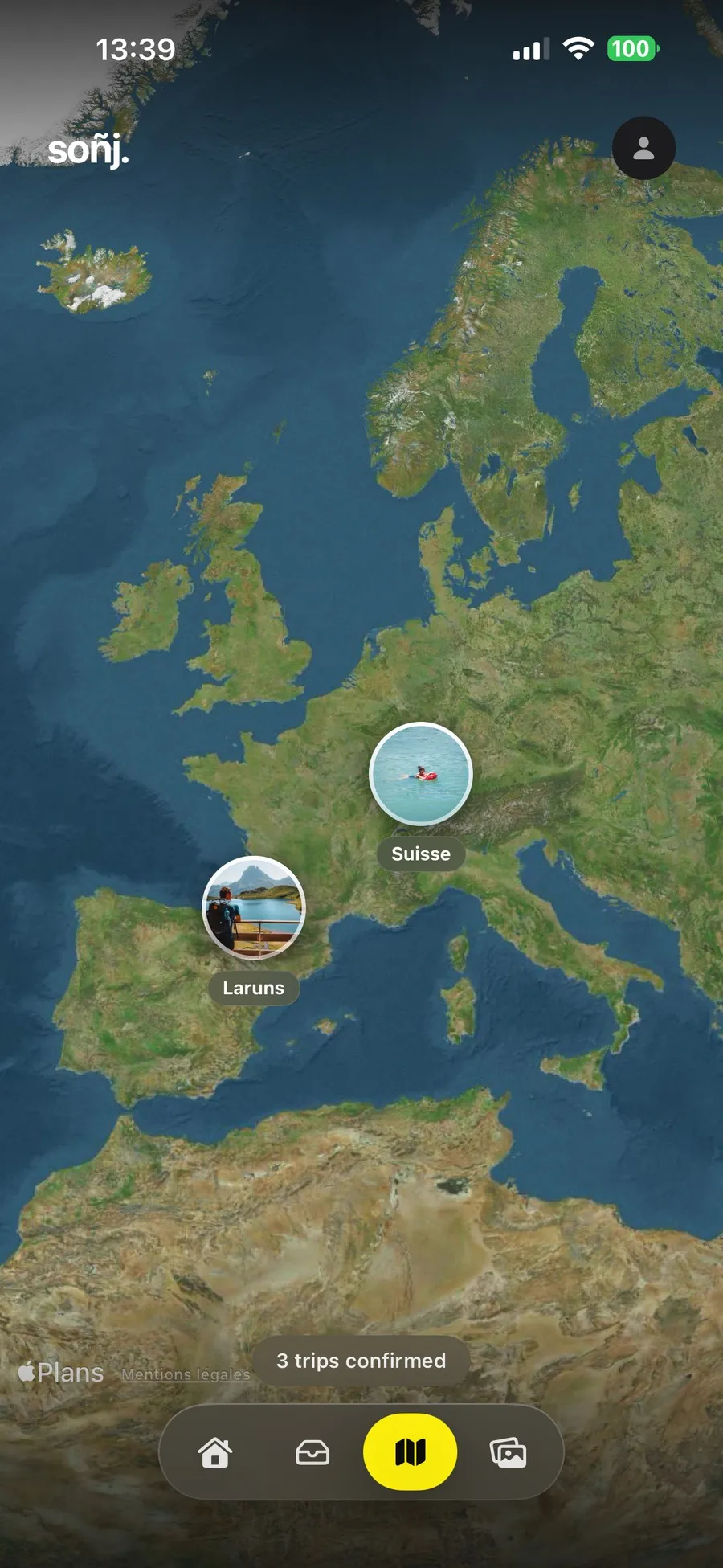
The map tab places all your trips on the globe, each illustrated by one of its photos. It is the screen you open for no particular reason, and the one that best shows what a life of travelling looks like from a distance.
There is nothing to do on it. You spin the Earth, you recognise a summer, you open the trip.
06 The poster
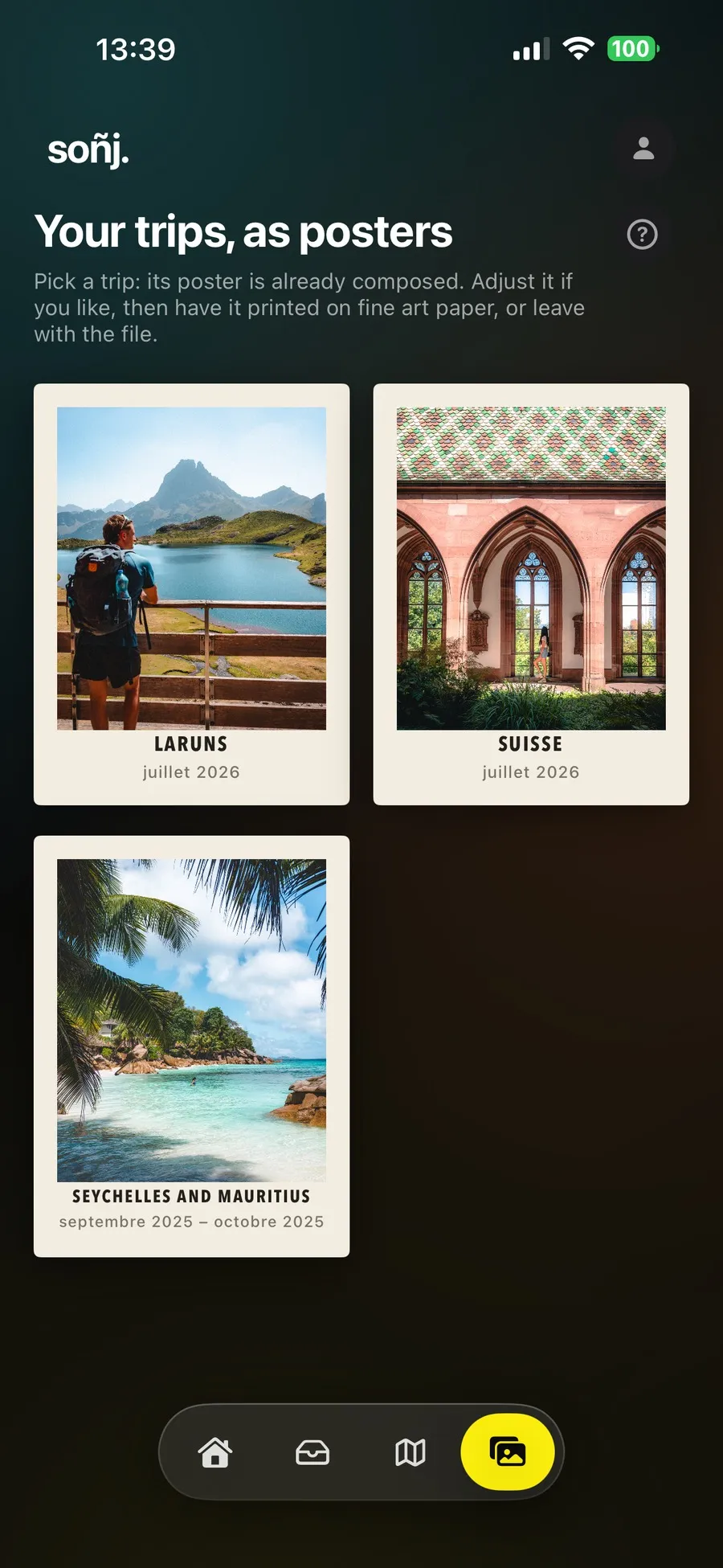
The moment a trip is confirmed, its poster exists. Not an empty template to fill: a finished poster, with its photos chosen, its title and its dates in place. There is no layout for you to do, only adjustments if you feel like making them.
That is the bet the product makes. A layout you have to do yourself is a project you put off. A poster that is already done is a decision: that one, or not that one.
What you correct in the journal shows up on the poster. A renamed place, a discarded photo, a changed cover: the poster follows.
07 The templates
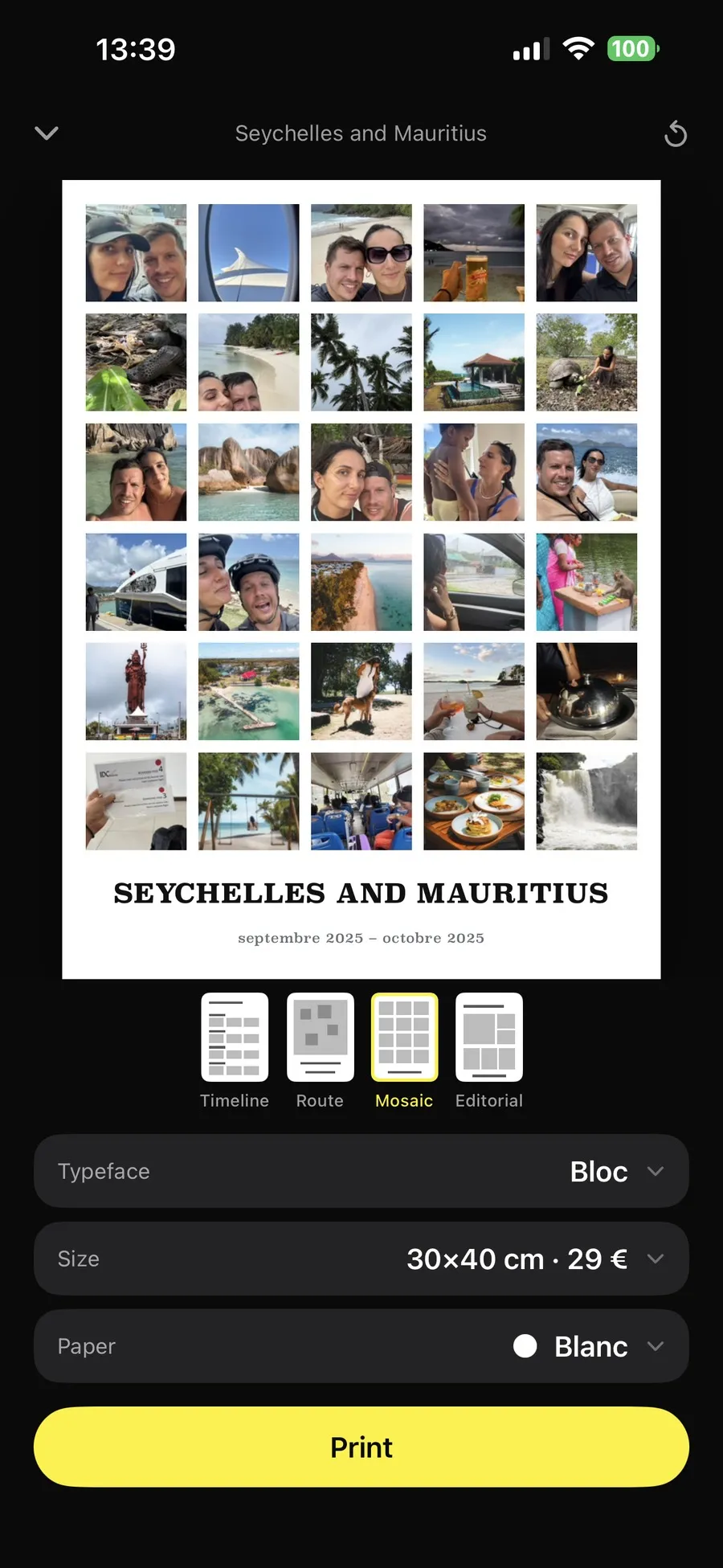
Four templates, which don't tell the same story. The timeline unrolls the trip in bands of days, from departure to return, and it is the signature template. The route lays out the map of the ground covered, photos as pins joined by the line. The mosaic gives you the plate, many photos at equal size. The editorial picks one dominant photo and its supporting ones, magazine style.
Five typographic voices, chosen to be five eras rather than five shades of the same thing: Mode and its high contrast didone, Affiche and its condensed grotesque, Atelier and its spaced fifties capitals, Bloc and its national park slab serifs, Tampon and its engraved luggage-tag capitals.
Two papers for now, pure white and cream. Two dark grounds are drawn and ready, but held back until the control print has been measured: a dark flat that runs to the trim line leaves a white sliver at the slightest cutting drift.
The trip is worked out from the dates and locations already written into your photos.
No background location, no live tracking. The app only reads what already exists.
What you like in Soñj is written back into Apple's photo library.
One page at the size ordered, no transparency, embedded fonts, a 12 mm safety margin.
Both are offered side by side, neither one blocking the other.
The print is produced and shipped by Peecho, on a 200 gram enhanced matte fine art paper. Payment happens on their page, and order tracking comes back into the app, on the Profile page.
| Size | Price, shipping and VAT included |
|---|---|
| 30 x 40 cm | €29 |
| 45 x 60 cm | €39 |
| 60 x 80 cm | €49 |
| 75 x 100 cm | €69 |
Outside France the price is recalculated in the delivery country’s currency: shipping and local VAT are priced on the fly, the margin doesn’t move, only the display follows.
The file on its own is €4.99. It is produced before any payment, which means that if the render fails, nothing is charged. Once paid for, it stays findable from the Profile for as long as the app is installed.
The photo library analysis runs on the device, entirely. No photo and no location is sent to a server. The only file that leaves is the print PDF, and only when you order a print.
Photos other people sent you are excluded by default. They carry somebody else’s location, and including them would mean rebuilding a stranger’s trip inside your own.
The places you live serve only to stop everyday life being mistaken for a trip. That information does not leave the device.
Soñj isn’t on the App Store yet. The detection engine runs, the four templates compose, and the PDF comes out compliant. What’s left is testing the in-app purchase in the sandbox, publishing the legal pages, and measuring the control print so the two dark papers can open.
Beyond that, in the order I am working on them: the photo book, framed prints, the “three years ago” reminder, and route tools in the journal.
What the app reads in your photo library, what leaves the moment you order a print, and what my server never sees are set out in the Soñj privacy policy. Who sells the print, who charges for it, who delivers it, and what to do if the parcel arrives damaged are in the terms of use and sale.
By reading your photo library's metadata. Every photo taken with an iPhone carries its date and its location. Soñj groups those points, spots the stretches spent away from the places you live, and rebuilds your trips with their stages and their places, with nothing for you to type.
No. There is no background location and no live tracking. The app only reads what is already written into your photos, and the analysis runs on the device. Photos received from other people are excluded by default, because they carry somebody else's location.
No. No photo and no location is sent anywhere. The only thing that leaves the iPhone is the print file, and only at the precise moment you order a print.
The "To sort" tab lets you judge each proposal alongside the reasons that produced it. You confirm, you reject, you fix the dates, you split a trip in two or merge two into one. Nothing is confirmed without you.
From €29 at 30 x 40 cm to €69 at 75 x 100 cm, with €39 at 45 x 60 and €49 at 60 x 80. Those prices include VAT and shipping for France. The paper is a 200 gram enhanced matte fine art stock.
Yes, for €4.99. You get the print-ready PDF and have it printed wherever you like. The file is produced before any payment, so if the render fails nothing is charged.
French and English, in full. The app follows the iPhone's language, and the Profile lets you force one without touching the phone's settings.
From Breton. Soñj means the memory, the thought you hold on to. I live in Brittany and the app does nothing else, it finds memories that already existed.
Coming soon
Soñj is coming very soon.