How to prepare for a job interview out loud
Reading questions prepares you for nothing. Here is how to prepare for a job interview in seven steps, working on what actually decides the day, speech.

Business
Nelo
Nelo is a mock interview app: a voice recruiter calls you, works from your CV and the job you are aiming at, then hands back a report on what you said.
Free and no card needed: CV import, one in-depth analysis, unlimited postings, the CV against the posting comparison, a two-minute Introduce yourself with its report, history and progress. Signing in with Apple is asked for voice sessions and for any purchase. Premium opens the five to fifteen minute voice interviews, with an envelope of 45 minutes a week or 100 minutes a month.
3 roles
a planner that prepares, a recruiter that speaks, an evaluator that scores
5, 10 or 15 min
the length you pick, at a gentle, realistic or demanding level
14 per 100 words
your filler words counted, then tracked from one session to the next
01 Where this started
The night before an interview everyone does the same thing: look up the classic questions, write good answers in their head, decide it will be fine. The next day they stumble on tell me about yourself, head off in three directions at once, and hear themselves doing it without being able to stop.
The gap is not knowledge. It sits between knowing what to say and saying it out loud, in real time, to someone who waits, follows up, and does not fill the silences for you.
That is why Nelo is not a chatbot. It is a call. You pick up, someone asks a question, and you answer now.
You do not practise an interview by writing. You practise it by speaking.
02 The job
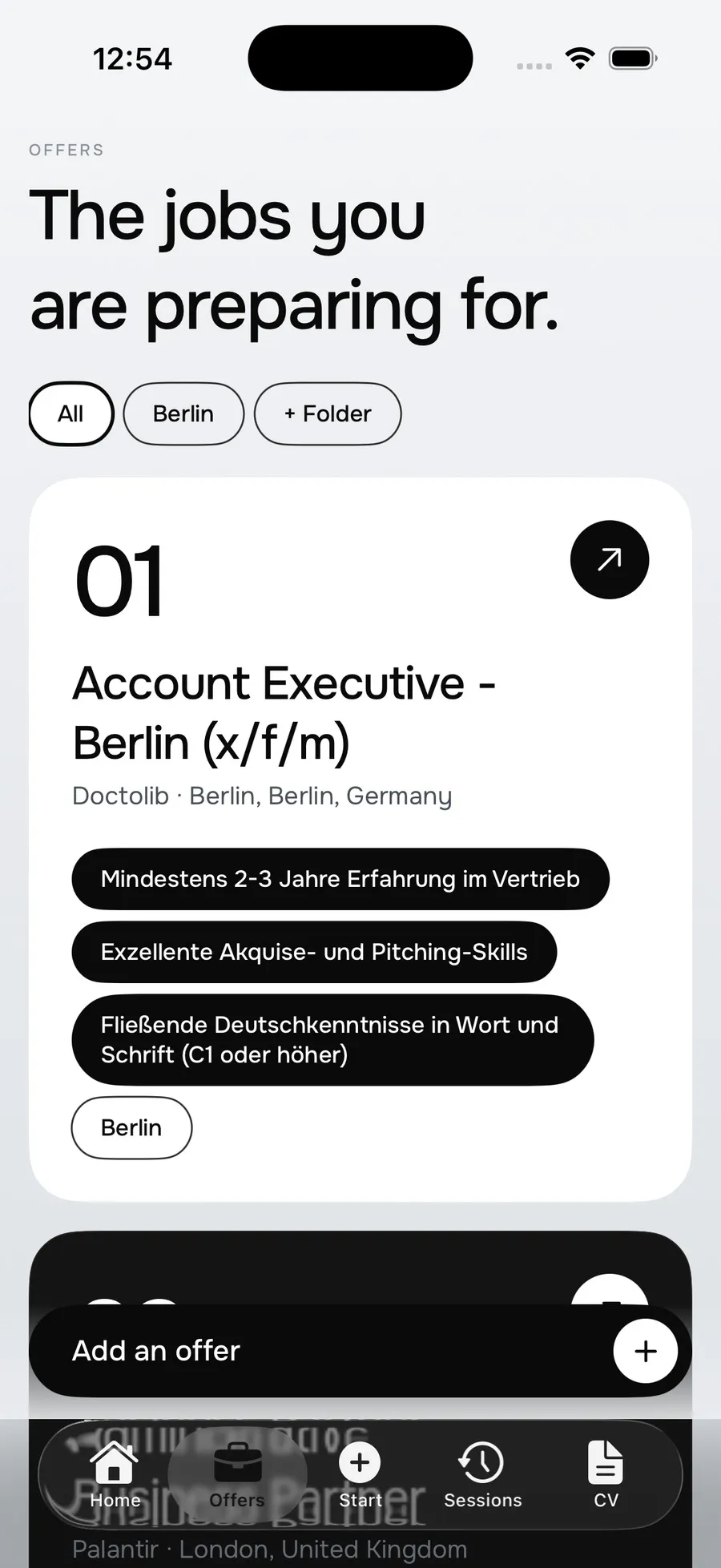
The main mode starts from two documents: your CV and the posting you are answering. The app reads both, pulls out what the role really demands, and holds it against your track record.
In the screenshot, an Account Executive role in Berlin at Doctolib. Three requirements came out of it, one of them fluent written and spoken German. These are not keywords picked at random: they are the points a real recruiter will press on.
You can also practise with no posting at all, on a generic role, or pick an HR, behavioural, technical or high-pressure format. But the targeted interview is the one that changes something, because it asks the questions of that interview.
03 Before you pick up
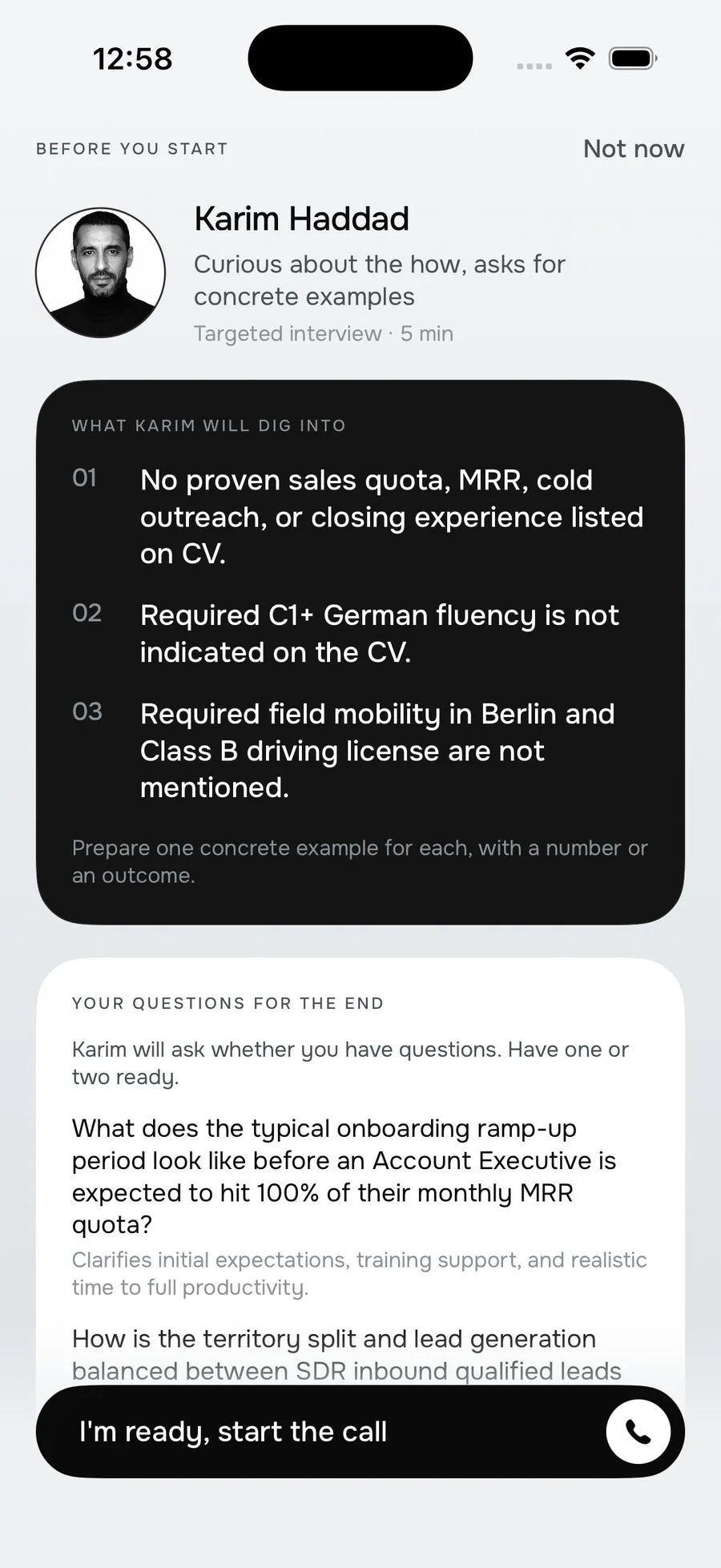
This is the design decision I am happiest with, and it cuts against instinct. Just before the call, the app shows the three things the recruiter is going to push on.
In the screenshot: no formal development training detailed on the CV, a career change with twelve years of experience applying for a junior role, and a technical contribution left vague on a 1.2 million euro project. Three real weak spots, written down, before anything has started.
A test would hide those to see whether you fall in. A training tool does the opposite: it gives you thirty seconds to line up a concrete example for each. You came to get better, not to be caught out.
The same screen offers two or three questions to ask at the end, each with the reason it is worth asking. That is the moment most people fluff, purely for lack of having thought about it beforehand.
A test traps you. Training warns you. Nelo warns you.
04 The call
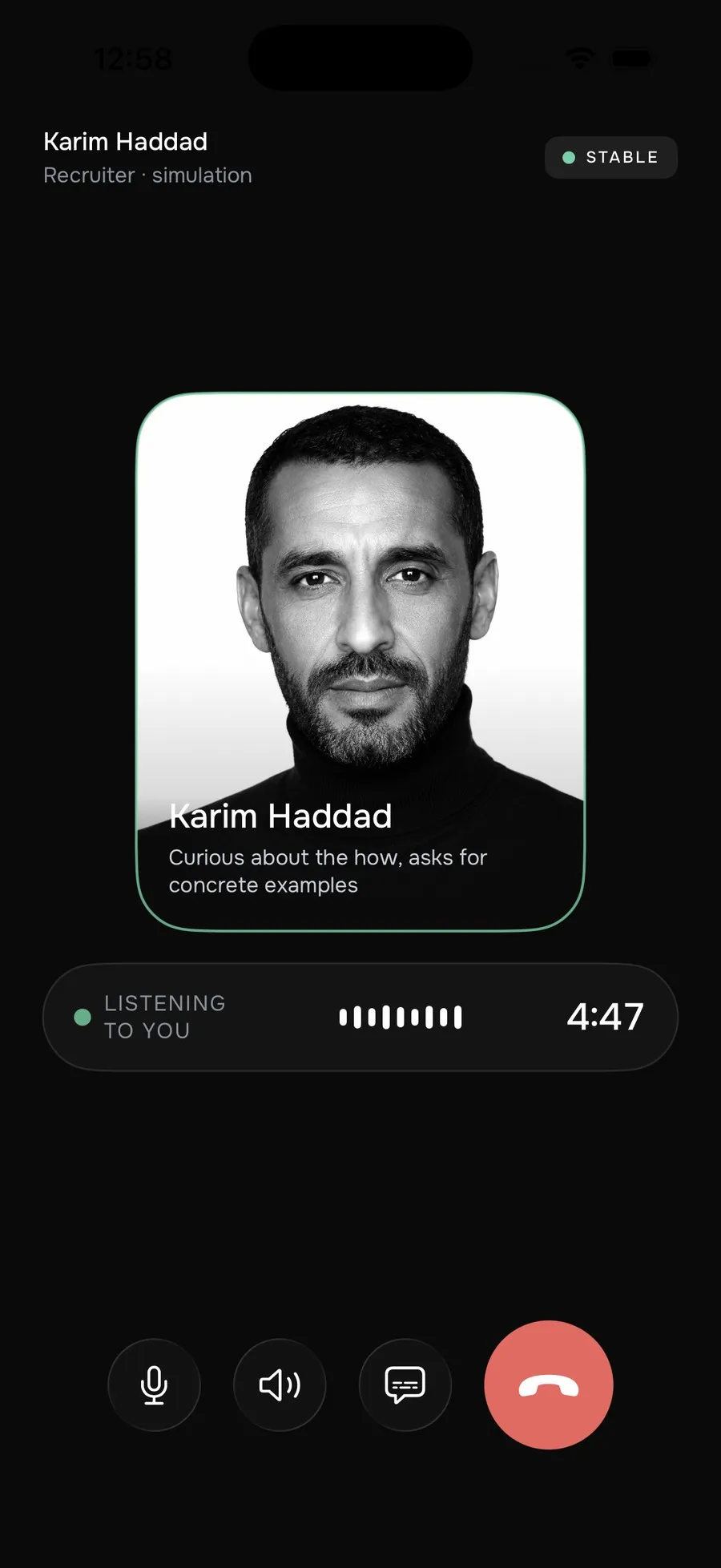
The screen goes black, the portrait appears, the timer starts. The recruiter asks, then stops talking and listens. One question at a time, never a list.
If something is missing from your answer, he follows up. If you stay general, he asks for an example. If you run long, he cuts in politely and moves on, the way it happens for real. No coaching is offered during the call: the simulation stays a simulation.
The difficulty setting changes behaviour, not manners. On demanding, the recruiter pushes back more and validates less. He never becomes humiliating, which would teach nobody anything.
Five, ten or fifteen minutes. A badge shows connection health, because a simulation dropping halfway through is the worst thing that can happen to it.
05 The report
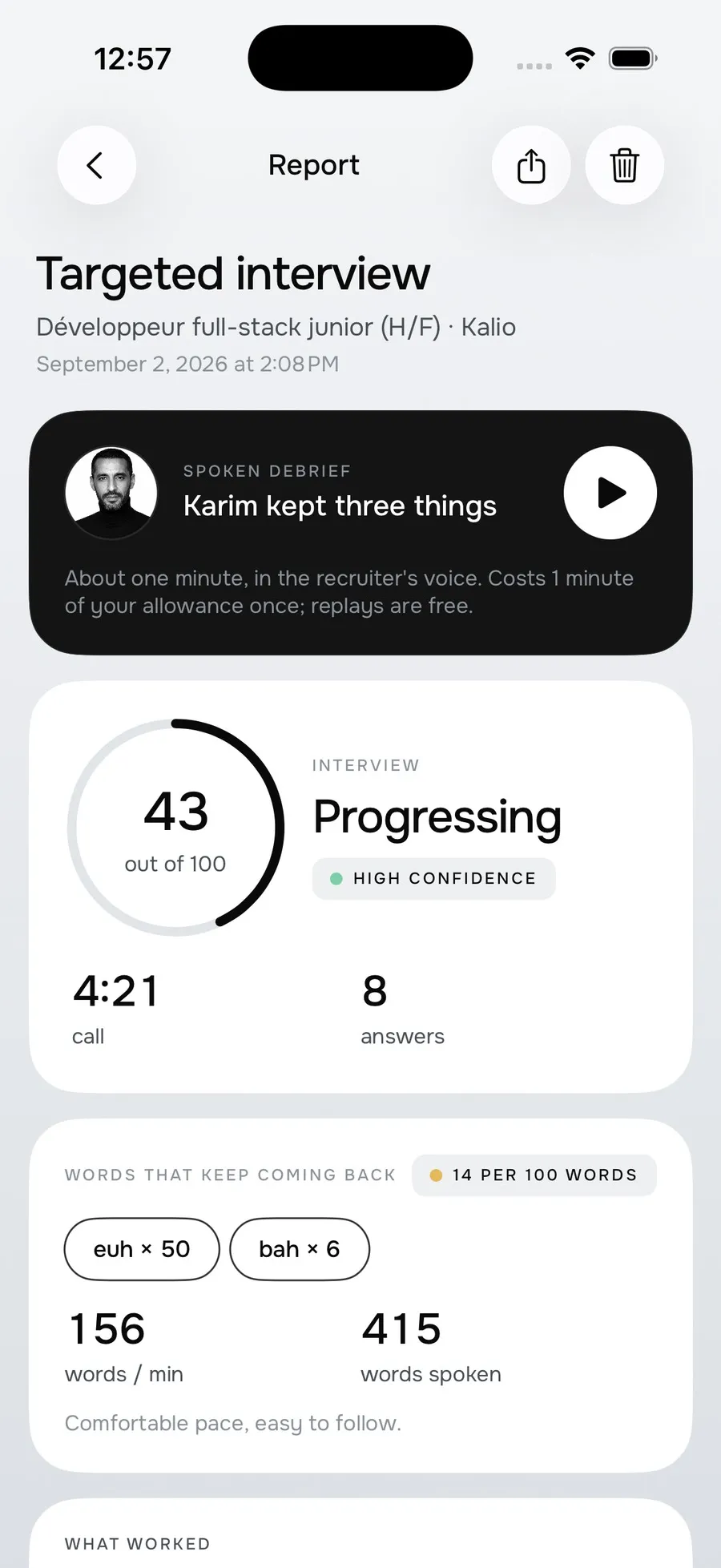
Seconds after you hang up, the report lands. A score out of 100, its sub-scores, and a confidence level next to it: on a four-minute simulation the number is indicative, and the app says so instead of pretending otherwise.
Then come the measurements that are not up for debate. 156 words per minute, a comfortable pace. 415 words spoken. And filler words counted one by one: fifty of one, six of another, fourteen per hundred words. Nobody hears themselves say those. Counted, they become fixable.
Every criticism points at a specific passage of what you said. Improved answers rework your own facts, and leave a blank where a number is missing. The coach never invents an experience for you.
At the top, a one-minute spoken debrief in the recruiter's voice. It costs one minute of your envelope, once, and replays are free after that.
06 Progress
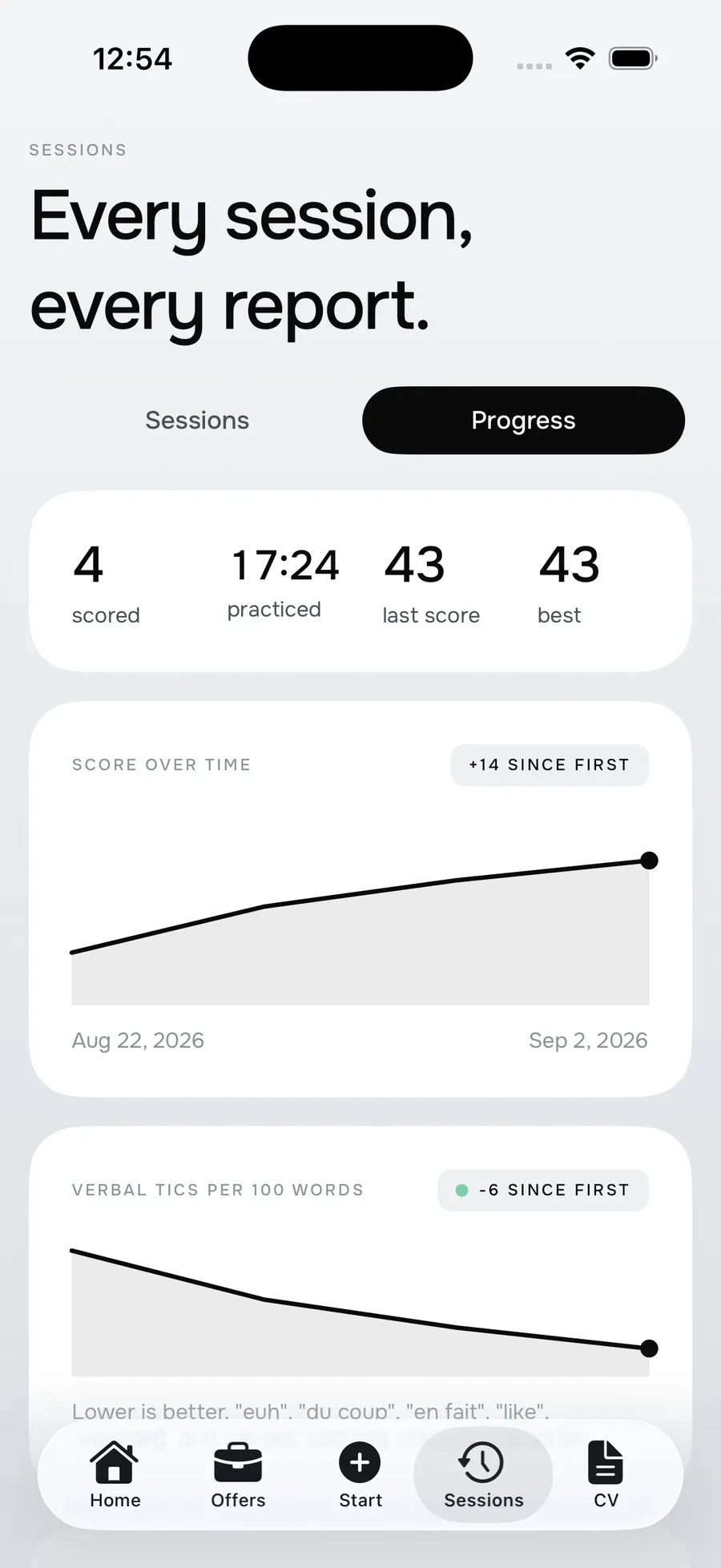
A single score is worth very little. Four sessions side by side are another matter: four scored interviews, seventeen minutes of practice, and a score that started at twenty-nine and reached forty-three.
The second curve is the one I watch most: filler words per hundred words, down six since the first session. That is a speech habit moving, and it moves because it got measured.
The home screen turns all this into a programme. One goal, one next step, and short drills to run during the day. Introduce yourself, two minutes, free: that is the format that brings people back, and it costs far less than a full interview.
The app extracts what the role demands and where your record falls short, then builds the interview on that.
Three vulnerabilities shown plainly, with time to prepare a concrete example for each one.
The ums and the you knows, counted per hundred words and tracked from one session to the next.
The coach reworks your own facts and leaves a blank where a number is missing, rather than adding experience you never had.
It cannot tell you whether you will be hired. No app can, and the ones showing a hiring probability are selling an invented number. Nelo measures a performance inside a simulation, against a grid it displays, and nothing more.
It does not read your face either. Automatic facial expression analysis is both unreliable and intrusive, and it tells someone trying to answer better precisely nothing. What gets measured here is observable: what you said, how fast, with which filler words, and with which pieces missing.
Finally, it does not replace a real recruiter. A simulation stays a simulation, with someone on the other end who has no team, no budget and no instinct. What it does give you is repetition: the tenth time you explain your career change, you explain it better than the first.
This is the architectural point that interests me most, and it explains why the app does not behave like a normal assistant.
The planner reads the CV and the posting before the call, and builds an interview plan with phases, questions and things to probe. The voice recruiter only runs the conversation, with latency low enough that interrupting still works. The evaluator comes in afterwards, on the full transcript, once it has all the context.
Three separate roles, three different models, each picked for what it does well. A single model doing all three would do each of them worse, cost more, and produce scores that drift between sessions for no reason.
Nelo is not published yet. The screenshots on this page come from the app as it runs on my iPhone today, in French and in English.
What is left is the least spectacular and most important part: getting the cost of a minute of conversation right, and checking that scores stay stable from one session to the next.
This page will be updated on release day.
A CV carries your name, your address, your career and sometimes your photo. It is the most sensitive document any of my apps asks for, which is why it gets redacted on the device before anything is sent. What stays on the iPhone, what goes to Supabase, ElevenLabs and the model providers, and what gets erased when you delete your account, is all in the Nelo privacy policy.
The rules of the service, what is free, how the envelope of minutes works and the legal notice are in the terms of use.
You add your CV and the job posting, pick the interview type, the length and the difficulty, then take the call. A voice recruiter runs the conversation, asks one question at a time and follows up when an answer stays incomplete. Afterwards the app analyses the transcript and produces a report.
No, and that is deliberate. It measures how you performed in one simulation, against a grid it shows you. It runs no psychological analysis, does not judge your face, and does not claim to know what a recruiter will decide.
No. With no CV and no posting you can work on a generic role or run a short drill such as Introduce yourself. The CV and the posting are what move you from plausible questions to the questions of your interview.
Five, ten or fifteen minutes, chosen before you start. There is also a one-question format of around two minutes, for practising daily without giving up an evening.
An overall score and its sub-scores, a confidence level, your strengths, your priority improvements, your pace in words per minute, your filler words per hundred words, a question-by-question review, and improved answers built only from what you actually said.
CV import and profile, one in-depth CV analysis, unlimited postings, one comparison between the CV and the posting, a two-minute Introduce yourself with its report, history and progress. No card required. Premium opens the five to fifteen minute voice interviews, the full report, the spoken debrief and retaking a question.
Premium gives 45 minutes of conversation a week on the weekly plan, or 100 minutes a month on the monthly and yearly plans. Each call is counted against the minutes actually used. A call shorter than one minute is not counted at all, and produces no report. The spoken debrief costs one minute, once per report. A 60-minute top-up is bought separately, with no renewal.
The full text of the CV never leaves the iPhone. It is read on the device, then stripped of the surname, age, address, phone number, email and sensitive details before anything is sent: only the first name travels. As for the interview, audio is never recorded, only the written transcript is kept so the report can be written, and all of it can be erased from the app's settings.
Not to get started. The app opens with an anonymous identifier, which is enough to import a CV, add postings, compare them and read your history. Signing in with Apple becomes necessary to start a voice session and for any purchase: it is what ties your envelope of minutes to you, and what lets you find your reports on another phone.
It is not on the App Store yet. This page will be updated on release day, with the download link in place of this sentence.
Coming soon
Nelo is coming very soon.